
Understanding the Importance of Zincs in Marine Surveys
What Used Boat Buyers and Insurance Underwriters Need to Know
In a pre-purchase or insurance marine survey, few items seem as minor — yet reveal as much — as sacrificial anodes, commonly called “zincs.”
They are inexpensive.
They are easy to replace.
And when neglected, they can quietly cause thousands of dollars in damage below the waterline.
For buyers and insurers, zinc condition is often a direct reflection of overall vessel maintenance and corrosion risk.
Why Zincs Matter During a Survey
Zincs protect a vessel’s underwater metal components from galvanic corrosion — a natural electrochemical process that occurs when dissimilar metals are immersed in water.
They are typically installed on:
Propeller shafts
Trim tabs
Rudders
Through-hulls
Outdrives
Transom assemblies
Heat exchangers
Their job is to corrode instead of the expensive hardware they are attached to.
When they fail — or are neglected — the protected metals become the next target.
What Zinc Condition Tells a Buyer
During a pre-purchase survey, zincs provide insight into:
1. Maintenance History
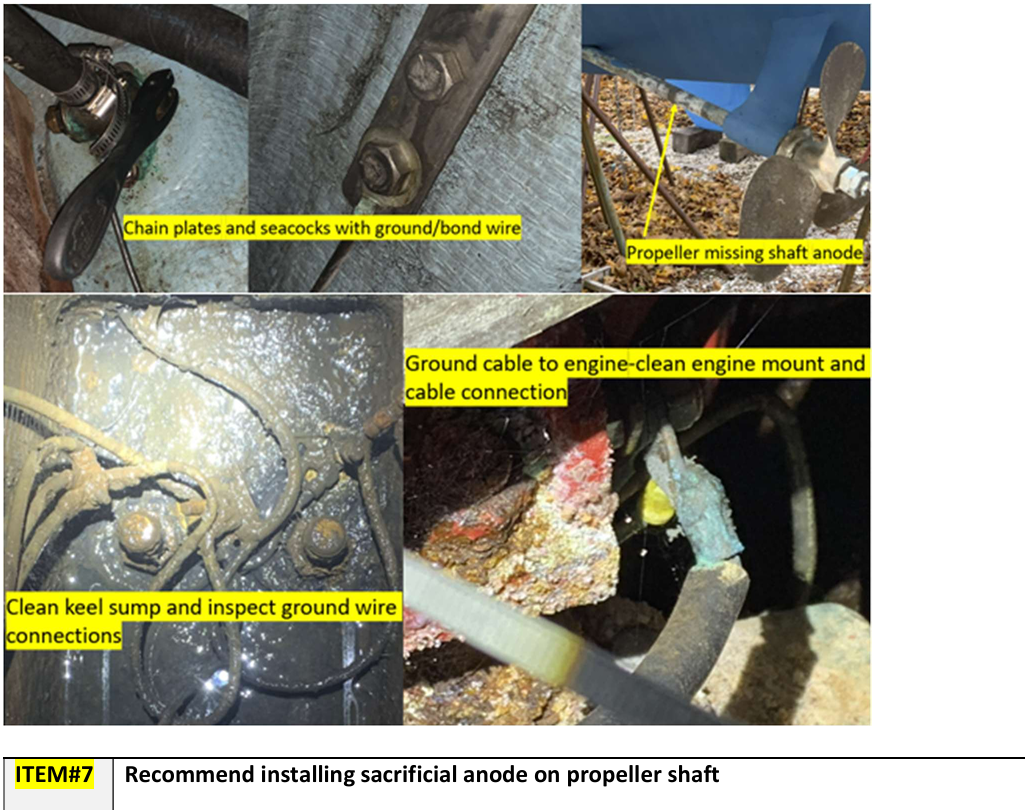
In this survey we see the zinc is missing entirely (upper right photo) and recommend replacement
Are anodes partially consumed but still functional?
→ Likely normal service intervals.Are they completely gone?
→ Possible deferred maintenance.Are they painted over or loose?
→ Possible lack of oversight during haul-outs.
Buyers are not just purchasing the vessel — they are inheriting its maintenance habits.
Zincs often reveal whether the boat has been proactively cared for or reactively repaired. Zincs are an easily overlooked annual item that can cause problems over time.
2. Corrosion Exposure Risk
If zincs are severely wasted or unevenly consumed, it may indicate:
Stray current corrosion
Faulty shore power grounding
Inadequate bonding systems
Marina electrical leakage
Onboard wiring faults
In these cases, replacing zincs alone does not solve the underlying issue.
From an insurance standpoint, unresolved corrosion exposure represents increased risk.
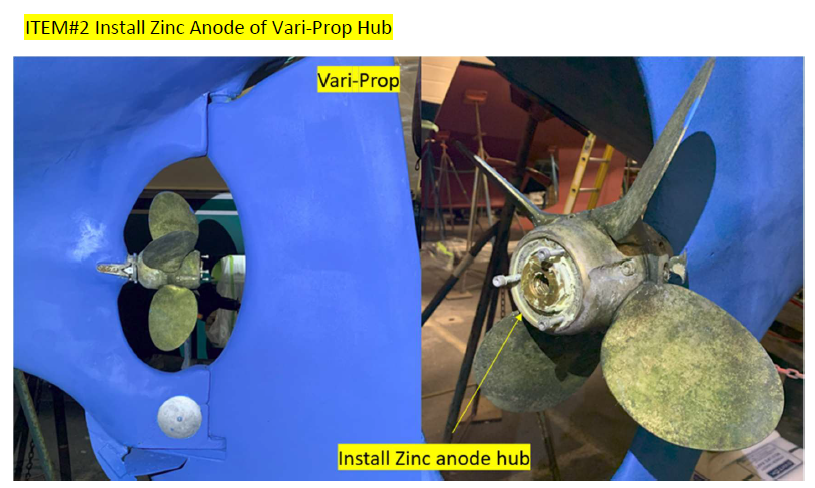
In this marine survey we recommended installing a zinc propeller hub anode in order to protect the propeller and shaft.
3. Hidden Damage Potential
When zincs are fully depleted, we inspect closely for:
Shaft pitting
Propeller blade erosion
Trim tab deterioration
Thru-hull weakening
Transom assembly corrosion
What begins as a $40 anode replacement can become a $4,000 repair if ignored long enough.
Why Insurers Pay Attention
Insurance surveys are focused on risk mitigation.
Underwriters want confidence that:
The vessel’s bonding system is intact
Corrosion protection is active
No accelerated metal loss is occurring
There is no evidence of ongoing stray current damage
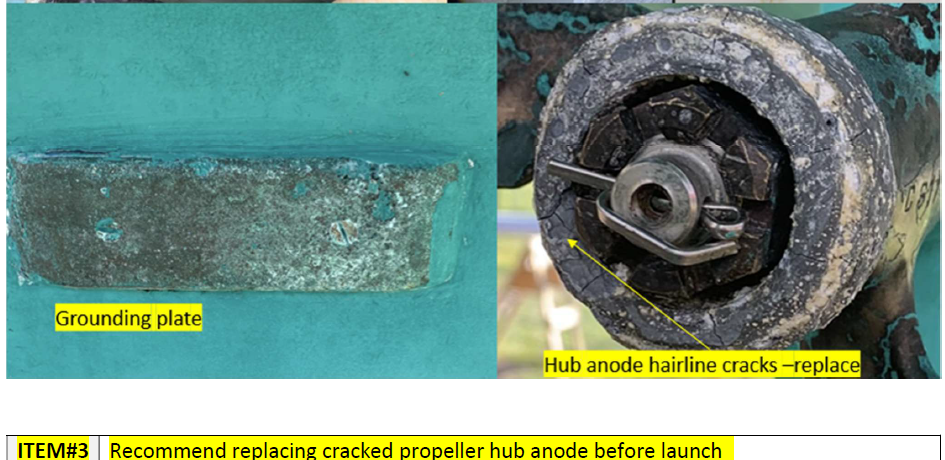
We recommended replacing this cracked anode as it could have fallen off unbeknownst to the owner.
Severely neglected zincs can raise red flags regarding:
Maintenance standards
Future claims potential
Electrical system integrity
Conversely, properly maintained anodes support a favorable risk profile.
Correct Anode Material Matters
Not all anodes are the same.
Zinc – Typically for saltwater
Aluminum – Salt or brackish water
Magnesium – Freshwater only
Installing magnesium anodes on a saltwater vessel can accelerate damage rather than prevent it.
Part of the survey process is verifying that the correct material is installed for the vessel’s operating environment.
For pre-purchase surveys it’s important to note which waters will be navigated to ensure the correct zincs are installed. We made such a recommendation when one of our clients intended to move their new boat from salt water to freshwater.
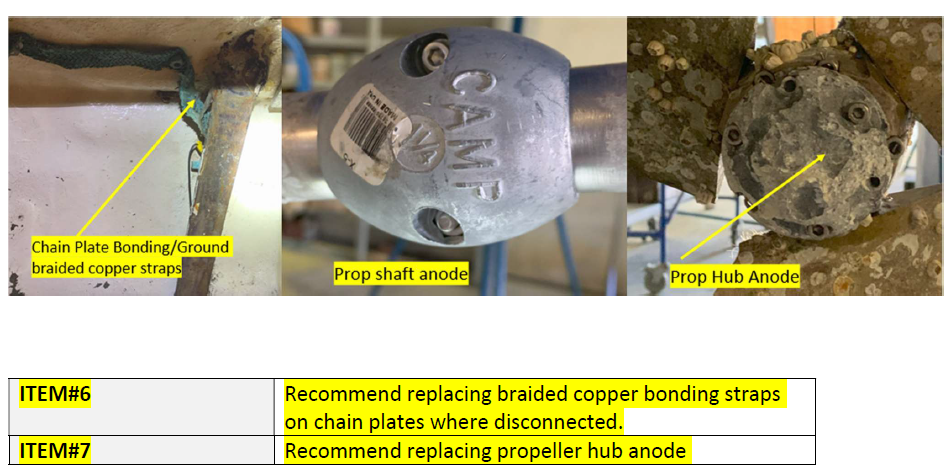
In this survey we recommended replacing the propeller hub anode, the shaft anode was in good condition.
Common Zinc-Related Findings in Surveys
Some of the more frequent findings include:
Missing shaft anodes
Completely depleted trim tab zincs
Detached bonding wires in the bilge
Painted-over hull anodes
Heat exchanger pencil zincs reduced to wire cores
Incorrect anode material for the marina environment
Individually, these may seem minor. Collectively, they can indicate a pattern.
The Bottom Line for Buyers and Owners
For buyers, zinc inspection helps answer one key question:
Has this boat been maintained in a way that protects its most expensive underwater components?
For owners renewing insurance:
Regular inspection and replacement of zincs is one of the simplest and most cost-effective ways to demonstrate responsible maintenance and reduce corrosion risk exposure.
Final Thoughts
Zincs are not just a maintenance item — they are an early warning system.
In a marine survey, their condition provides valuable insight into:
Electrical integrity
Corrosion exposure
Maintenance habits
Future repair risk
Small components.
Big implications.xt on the role of zincs